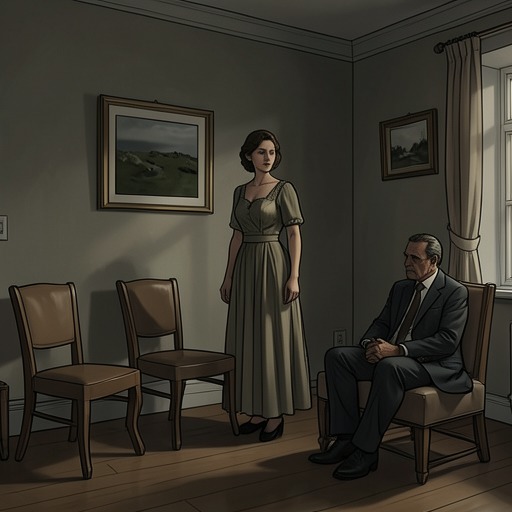
Futh’s parents’ marriage
The Lighthouse (Alison Moore Edition)Futh’s parents’ marriage is defined less by shared intimacy than by a recurring pattern of one-sided talk, visible impatience, and withdrawal. For Futh, its decisive meaning becomes clear during a family holiday in Cornwall: familiar friction between his parents gives way to his recognition that his mother is leaving. The marriage is thus seen both from within its daily habits and through the child’s belated understanding of their consequence.
Domestic Signs of Separation
The family home bears the marks of an unfinished shared life. When they moved there, while Futh was seven, his mother measured for kitchen curtains but never made them. She planned to repaint the whole house and completed only the landing; many pictures brought from their previous home remained unhung, and the flowerbeds, though planted, eventually grew wild. These details do not establish a single cause for the marriage’s decline, but they make its instability tangible: plans begin, then remain incomplete, while the house continues to display what was not finished before his mother left.
The family’s ordinary routines also place Futh between adult relationships he cannot control. At one meal, his father tells him not to speak to Gloria. They eat oxtail soup while Futh watches lights go out and come on across the back gardens. His father then leaves, instructing him to finish eating and go to bed; the cold air enters through the open kitchen door and remains after he is gone. The scene does not explain the parents’ marriage by itself, but it shows a household in which departures and unspoken tensions are already part of Futh’s everyday observation.
A Repeated Pattern of Friction
On the Cornwall cliffs, the conflict between his parents has a recognizable rhythm. His father talks about wrecking and plundering and tells a story about a ghost ship repeatedly crashing near the lighthouse. His mother rolls her eyes, fidgets, sighs, and makes remarks that indicate her impatience. Futh has seen this pattern before: his father continues speaking, his mother responds with provocation, and silence or a flare of temper may follow. His father loses his temper easily, though the anger passes quickly. The scene presents discord not as a new quarrel but as a familiar sequence, one Futh already knows how to anticipate.
His father’s attention to the lighthouse intensifies that imbalance. He continues explaining its light and foghorn while his mother lies in the sun, and Futh wanders away with the perfume taken from her handbag. When he returns, his father is still talking, or has resumed where he left off. His mother’s response makes plain how little patience remains for this familiar performance. The episode’s significance lies not simply in disagreement over the subject, but in the repetition: his father holds the floor, his mother withdraws or interrupts, and Futh watches for what will happen next.
The Cornwall Holiday and Its Aftermath
The lighthouse also carries a private connection between the adults. Before the cliff scene, Futh’s father gives his mother Futh’s silver lighthouse perfume case. She admires it, approves of the scent, and applies the perfume. Later, Futh returns with the vial removed from its case; it breaks in his hand, and the perfume spills. His father silently packs the picnic, putting away the plates, beakers, coffee, and blanket. His mother eventually gets up and says she is going home. The family collects its luggage from the caravan site that afternoon and takes the train back from Cornwall.
Their conduct on the journey sustains the separation rather than resolving it. His father goes to the buffet car and does not return until they are nearly home. His mother falls asleep against the train window, while the perfume case holding the broken vial remains in Futh’s pocket. Her scent is associated with the orange she has eaten, whereas Futh’s hands and boots carry the smell of violets. Years later, when he works in the manufacture of artificial odours, octyl acetate makes him feel sad. The marriage’s fracture therefore persists in his memory through sharply distinct traces: the object his father gave, the scent that spills from it, and the different smells associated with each parent.
Recognition and Narrative Significance
On the train, Futh understands that his mother is leaving the family. He wants the journey to slow and the train never to stop; he wishes his mother would keep sleeping and his father would remain in the bar. Instead, his father returns, his mother wakes, and the train reaches its station. The passage places Futh’s certainty beside the ordinary forward motion of the journey: he can recognize what is coming but cannot delay or prevent it. The evidence establishes his knowledge that she will go, without detailing the later circumstances of her departure.
This marriage is consequently presented through accumulation rather than an explanatory account of its history. The unfinished curtains, abandoned painting, and wild flowerbeds make separation visible in the family home; the repeated exchange on the cliffs shows how friction has become routine; and the train turns that routine into a consequence Futh can name to himself. The scent of violets then gives the moment an afterlife in his adult memory. What Futh retains is not a reconciliation or a final explanation between his parents, but the pattern he witnessed and the journey on which he understood that the family was about to change.